



If you’re like most Australians over a certain age, you’ve probably had your car’s air con regassed at some point – and figured a struggling home system probably works the same way. So, how much does an aircon regas cost sounds like a perfectly reasonable question, and we get asked it a lot.
However, an aircon regas for a home system is nothing like routine car maintenance. Understanding exactly how it’s different changes the entire picture – both for what you should expect to pay and for what the job actually involves.
Why home systems are different to your car
A car’s air conditioning compressor has a shaft seal that – at some point – will simply wear out over time, letting out small amounts of refrigerant as a normal part of ageing in the process. Topping it up periodically is therefore completely expected and built into the design, and most drivers get it done without a second thought.
But a home split or ducted system works nothing like that. It’s a completely sealed loop – and refrigerant isn’t burned off or consumed the way fuel is; it just circulates continuously between the indoor and outdoor units for the system’s entire working life. So if a home unit really is low on gas, that refrigerant has to have gone somewhere.
Where did it go? It’s vanished … almost certainly because of a leak.
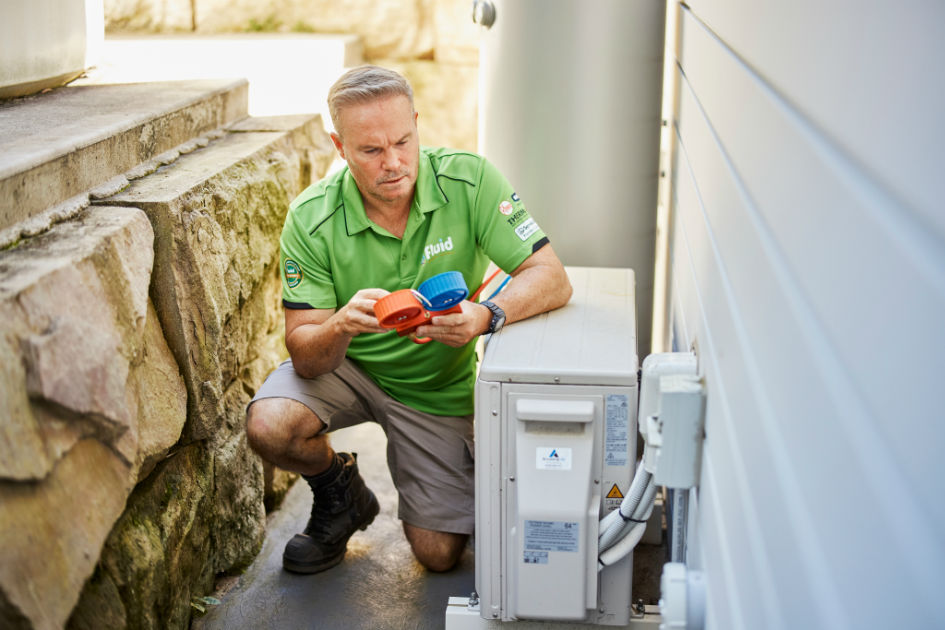
It’s at this point that you start to realise the cost implications – because – like we said – an air conditioner regas on a home system isn’t really routine maintenance at all. It’s a repair. And in Australia, refrigerant handling requires an ARCtick licence, with clear guidance that a leaking air conditioning system shouldn’t just be topped up without finding and fixing the source first.
A regas without addressing the leak is a short-term fix that leaves you paying for the same job again within months.
What actually affects the cost
Once you know it’s a repair job rather than a service, the actual cost to regas home air conditioner units comes down to a handful of variables.
Here they are:
1. Whether there’s a leak at all
A simple top-up, where a system’s only slightly low and there’s no detectable leak, comes in at the more affordable end.
Once leak detection and an actual AC repairs are involved, the job takes longer and costs more – since finding a small leak in a sealed system isn’t always straightforward, and it might mean pressure testing several joints and fittings before the source turns up.
2. What refrigerant your system runs on
Most split systems installed since around 2018 use R32, with older units commonly running R410A. You don’t need to know much about either of them – and both are still readily available. So that should keep the split system aircon regas cost at relatively predictable levels across most standard jobs.
However, anything old enough to run R22 – sometimes still called Freon – is a different story altogether. Why’s that? Because R22 was actually phased out under the Montreal Protocol and can no longer be legally imported.
What’s left comes from reclaimed stock, which costs considerably more and is only getting scarcer.
3. System type & size
A single wall-mounted split system generally uses less refrigerant and takes less time to regas than a multi-head setup or a ducted system, both of which involve more refrigerant and often trickier access to the components that need attention.
A larger household running several indoor units off one outdoor compressor should expect a bigger job overall, purely because there’s more system to check. The size of the air conditioner also plays a role, with larger-capacity systems typically requiring more refrigerant than smaller units.
4. How accessible the unit actually is
An outdoor unit tucked into a tight side passage or up on a difficult roofline takes longer to work on than one sitting in an open, easily reached spot, and that extra time shows up in the final cost regardless of what’s actually wrong with the system.
It’s one of those factors that has nothing to do with the refrigerant itself but unfortunately does change how long the job takes and how difficult it is for the technician.
5. Whether replacement makes more sense
If you’re chasing a leak on an R22 system, or dealing with a tired old unit that’s already had several repairs, deciding to regas split system air conditioner units can end up costing more over time than simply replacing the unit with something modern and efficient.
A good technician will tell you honestly when you’ve hit that point rather than continuing to chase a leak on borrowed time, even if that means recommending a job that earns them less on the day.
Getting a straight answer
Just want to know the honest cost to regas air conditioner systems? It’s impossible to say – because it depends entirely on what’s really gone wrong. And that’s exactly why a proper diagnosis matters more than any rough quote given over the phone anyway.
A technician who checks for a leak before recommending anything is giving you a real answer – rather than just refilling the gas and hoping it holds until the next hot spell.
If your system’s not cooling the way it used to, or you’ve been quoted for an aircon regas and want a second opinion before committing to something that feels a little off, get in touch with Fluid Air Conditioning.
Our friendly and experienced team of specialists will:
- Diagnose what’s actually going on
- Explain it in plain terms you can understand
- Tell you honestly whether a repair or a replacement is the better call for your system and bottom line.
Get in touch with Fluid Air Conditioning today.